
Can You Rank on Google with a Squarespace Website? Here Is What Local Businesses Need to Know
About Caresa Hope: Founder of HopeSpring Digital and a digital marketing strategist specializing in SEO, AI-ready content, conversion-focused web design, and business strategy that helps small businesses turn online visibility into measurable growth.
Key Takeaways
Squarespace websites can absolutely rank on Google, and the platform itself is rarely the reason a site is not showing up in search results.
For local service businesses, strategy matters far more than platform. Google Maps visibility, local citations, and a well-optimized Google Business Profile carry more weight than which website builder you chose.
A lean, well-built Squarespace site with focused content and proper on-page optimization can outperform a bloated, neglected site on any platform.
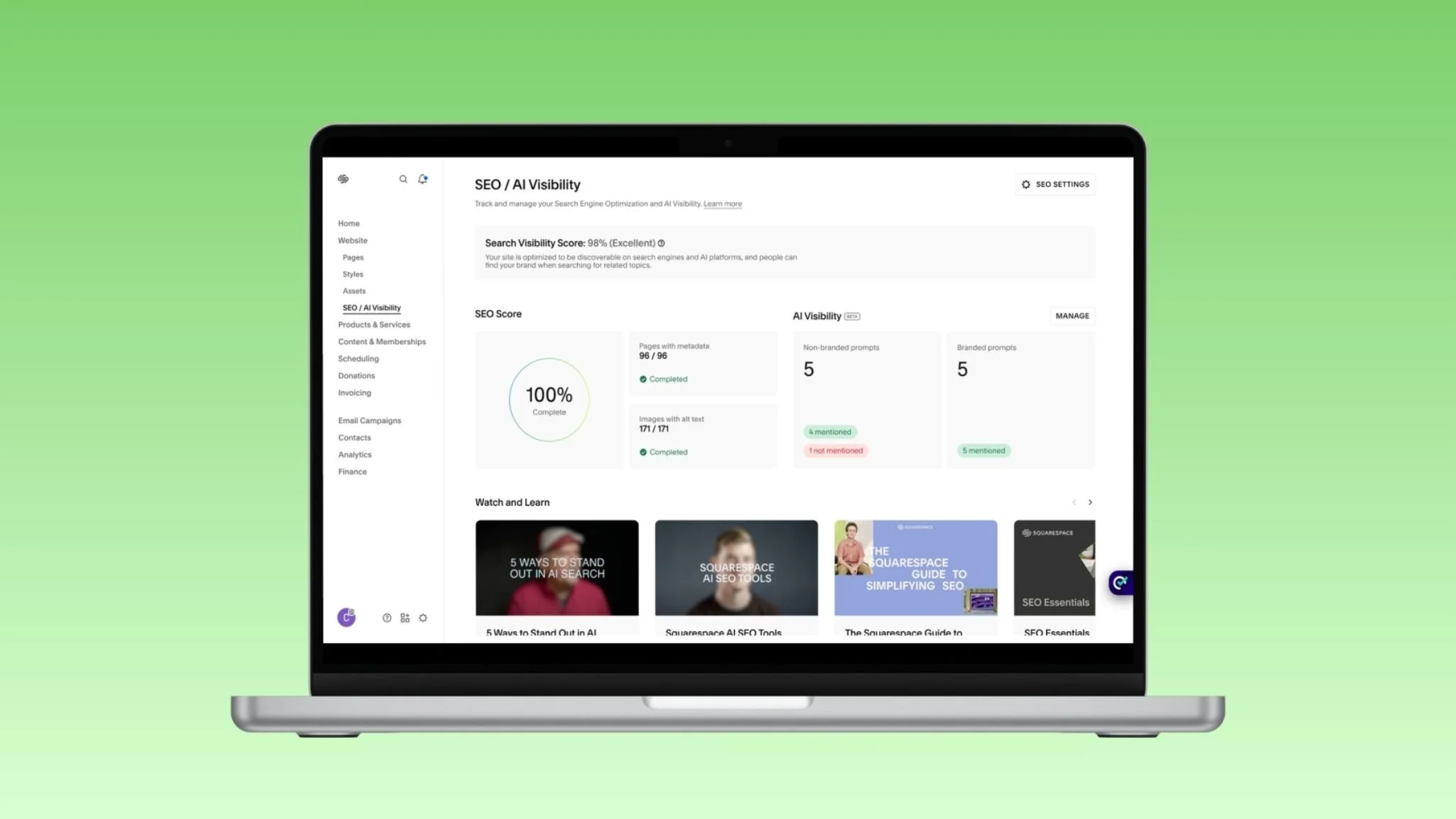
Google now automatically indexes Squarespace sites for AI-powered search results including Google AI Overviews and ChatGPT, which is a quiet but significant advantage for small business owners.
Most Squarespace sites fail to rank not because of the platform, but because of three fixable issues: missing metadata, no connection to Google Search Console, and no ongoing content or SEO strategy.
The Question Almost Every Small Business Owner Is Asking
You put in the work. You built (or had someone build) a Squarespace website that actually looks like your business. It is clean, it loads on mobile, and it represents what you do. But then a few weeks pass, and when you type your services into Google, your site is nowhere to be found. A competitor with a clunkier website is sitting on page one, and you are wondering if you made a mistake choosing Squarespace.
Here is the honest answer: Squarespace is not the problem.
The platform you choose matters far less than what you do with it. For small business owners who want to be found locally, the path to Google rankings is clearer than most people think. But it does require a real strategy, not just a beautiful design.
This guide is written for service-based businesses: the HVAC company in Maple Grove, the salon owner in St. Paul, the landscaper in Eagan, and the therapist in Minneapolis who all want the same thing -- to show up when a local customer is ready to hire someone like them.
Why Most Squarespace Sites Do Not Rank (And It Is Not the Platform's Fault)
Studies of large Squarespace site samples consistently show that the majority of Squarespace websites receive zero or near-zero organic traffic. That statistic sounds alarming, but the reason behind it is almost always the same: these sites were launched and left alone.
The three most common reasons a Squarespace site fails to rank have nothing to do with Squarespace itself:
1. The site was never connected to Google Search Console.
This is how you tell Google your business exists and is ready to be found. Without it, your site may take far longer to be indexed, and you have no visibility into whether Google can even read your pages properly.
2. Metadata was never filled in.
Every page on your Squarespace site has a field for an SEO title and a meta description. These are what appear in Google search results. When left blank, Google guesses, and it rarely guesses well. A local HVAC company whose page title reads "Home" instead of "HVAC Repair and Installation in Minneapolis, MN" is invisible in all the right searches.
3. There is no ongoing SEO effort.
A website is not a one-time project. Google rewards freshness, relevance, and authority built over time. Launching a site and doing nothing afterward is like opening a shop and never putting a sign out front.
None of these issues are Squarespace's fault, and all of them are fixable.
What Squarespace Actually Gets Right for SEO
Squarespace handles a meaningful amount of technical SEO automatically, which is a genuine advantage for small business owners who do not want to hire a developer to configure the backend of their site.
Here is what comes built in, without any extra setup on your part:
Automatically generated XML sitemap (a roadmap for Google's crawlers)
Clean, readable URLs
Free SSL certification (the padlock icon that signals your site is secure)
Mobile-responsive templates across the board
AI-powered SEO tools that suggest meta titles, descriptions, and image alt text
Automatic configuration for AI search discovery, including Google AI Overviews and ChatGPT
That last point is worth pausing on. As of 2025, every Squarespace site is automatically set up to be discovered and indexed by AI-powered search tools. As AI search becomes a larger part of how people find local services, this built-in support is an advantage that most small business owners do not know they already have.
The platform gives you a strong technical foundation. What it cannot do is write your content, research your keywords, or build the local signals Google needs to place you in front of customers in your specific market.
The Truth About Local SEO and What Actually Moves the Needle
For a local service business, the goal is not just to rank on Google broadly. The goal is to show up in the local pack, that map-and-listing section at the top of Google results when someone searches for a service near them. That is where most clicks go for local searches, and it is also where the competition is most direct and most winnable.
Ranking locally with a Squarespace site comes down to four things working together:
1. Your Google Business Profile
This is separate from your website and arguably more important for local visibility. Your profile needs to be fully completed, consistently updated, and actively collecting reviews. The quality and frequency of your reviews are a significant local ranking factor that no website builder controls.
2. NAP Consistency (Name, Address, Phone Number)
Every time your business is listed online, whether in Yelp, the Better Business Bureau, local Chamber of Commerce directories, or industry-specific sites, your contact information needs to be identical. Inconsistencies confuse search engines and erode trust.
3. Location-Specific Content on Your Site
A Squarespace site that mentions "plumbing services" without ever specifying "Minneapolis" or "Hennepin County" or the neighborhoods you serve is leaving local ranking potential unused. Here is what helps:
Dedicated location or service area pages
City and neighborhood names woven naturally into your copy
Locally relevant blog content that answers questions your community is actually asking
4. Backlinks and Local Authority
When other credible local sites link to yours, such as a local news outlet, a business association, or a community organization, it signals to Google that your business is legitimate and embedded in the community. These links are earned over time through relationships, content, and active participation in your local ecosystem.
A well-optimized Squarespace site that executes on all four of these areas can absolutely compete in local search, often faster than a business expects.
What About One-Page Squarespace Sites?
This comes up constantly for startups and solopreneurs: can a single-page website rank on Google?
The short answer is yes, with the right approach. Here is what a one-page site needs to do its job in local search:
A keyword-informed headline that reflects how your customers actually search
Service descriptions that use real, searchable language
A clear location signal throughout the copy
A strong meta title and description
A connected Google Business Profile doing the heavy lifting off-site
A one-page site will not rank for dozens of keywords. But for a solopreneur or startup that needs to establish a local presence, get indexed, and start building trust with Google, a lean and well-built site is a strong starting point and far better than a site that was rushed and never optimized.
Realistic Expectations: What to Expect in Your First 90 Days
One of the most frustrating things about SEO is the timeline. Here is an honest look at what Squarespace SEO for small business actually looks like when done correctly:
Days 1 to 30: Foundation
Connect Google Search Console
Fill in SEO titles and meta descriptions for every page
Optimize page copy with location-specific keywords
Compress and add alt text to all images
Claim and fully optimize your Google Business Profile
Days 30 to 60: Early Signals
Your site becomes indexed and begins appearing in Search Console data
You may start ranking for lower-competition, long-tail local searches
Begin publishing useful content (even one well-optimized blog post per month starts building topical authority)
Days 60 to 90: Compounding Momentum
Local pack movement becomes visible for targeted keyword phrases
Page one rankings for specific local searches become achievable
Your SEO strategy begins to compound with each new piece of content and each new local signal
SEO is not a switch you flip. It is a signal you build. The businesses that rank well on Google a year from now are the ones who started their strategy today.
The Platform Is Not Your Problem. The Strategy Is.
Squarespace is a capable, well-supported platform with a genuinely improving set of SEO tools. For most local small businesses, it is more than enough to support a strong Google presence.
The question was never really whether Squarespace can rank on Google. The real question is whether your site has been given the strategy, the content, and the ongoing attention it needs to earn that ranking.
The gap between where most Squarespace sites are and where they could be is not as wide as it feels. It is a matter of doing the right things consistently, and knowing which things to prioritize first.
Frequently Asked Questions
Does Squarespace hurt my chances of ranking on Google compared to WordPress?
No. While WordPress offers more flexibility through plugins, Squarespace handles the technical SEO fundamentals automatically and has closed most of the gap in recent years. For the majority of local small businesses, the platform difference is not the deciding factor in rankings. Strategy, content, and local signals are.
How long does it take for a Squarespace site to show up on Google?
After connecting your site to Google Search Console and submitting your sitemap, basic indexing can happen within a few days to a few weeks. Appearing on the first page of results for competitive searches takes longer, typically three to six months of consistent effort, though local searches can show movement faster.
Can a one-page Squarespace website rank in local search results?
Yes. A focused, well-optimized single-page site can rank for local keywords, particularly when paired with a strong Google Business Profile and consistent local citations. It may not rank for a wide range of terms, but it can absolutely rank for the specific service and location combination it is built around.
What is the most important thing I can do right now to improve my Squarespace site's Google ranking?
Connect your site to Google Search Console, fill in your SEO title and meta description for every page, and claim and fully optimize your Google Business Profile. These three steps cost nothing and remove the most common barriers to being found locally.
Does Squarespace support AI search results like Google AI Overviews?
Yes. As of 2025, Squarespace automatically configures all sites for discovery and indexing by AI-powered search tools including Google AI Overviews and ChatGPT. This is built into the platform and requires no additional setup, though strong, well-organized content still plays a major role in how prominently your site appears in AI-generated results.
Ready to Stop Guessing and Start Ranking?
At HopeSpring Digital, we work with Minnesota small businesses every day who are asking exactly the questions you just read through. Whether you need a high-converting one-page site that is built for SEO from day one, or an ongoing local SEO strategy that compounds over time, we can help you build something that does real work for your business. Our Local SEO Essentials and Growth SEO programs are designed specifically for service-based businesses who are ready to show up where their customers are searching. If you are not sure where to start, reach out. We would love to take a look at where your site stands and help you understand what is possible.